






Cost-Effective Pharma Instruments: Balancing Cost, Accuracy and Throughput
2026-08-21


In pharmaceutical quality control, the cheapest dissolution tester is not necessarily the least expensive system to operate. Analyst time, repeat testing, filtration, qualification, maintenance and instrument utilization all influence the real cost of producing a reportable dissolution result.

This is why Cost-Effective Pharma Instruments should be assessed through three connected variables:
• Accuracy: Can the system maintain controlled hydrodynamic and thermal conditions?
• Throughput: How many valid tests can be completed per shift?
• Operating cost: How much analyst intervention, rework and consumable use is required?
For automated dissolution testing, these three factors must be evaluated together rather than treating automation or purchase price as isolated advantages.
Accurate Dissolution Starts With Hydrodynamic Control
Dissolution results depend strongly on the flow field around the dosage form. Nominal RPM alone does not define that flow. Shaft alignment, vessel position, paddle depth and rotational stability all contribute to hydrodynamic reproducibility.
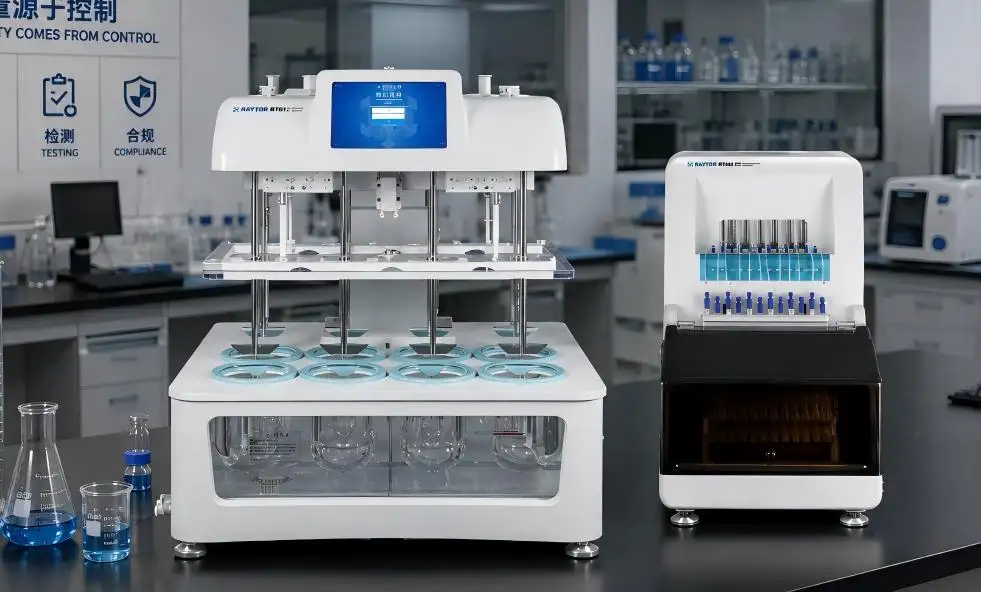
Raytor's 12-position automated architecture operates over 0–300 rpm, with 0.01 rpm resolution and steady-speed error of ≤±0.3 rpm. The distinction matters: resolution indicates how finely speed can be set or displayed, while steady-speed error better represents actual rotational control during a test.
Mechanical tolerances reinforce that control.
| Critical Control | Raytor Specification | Analytical Relevance |
| Vessel verticality | 90° ±0.5° | Helps maintain symmetrical vessel geometry |
| Shaft verticality | 90° ±0.5° | Reduces angular distortion of paddle/basket motion |
| Centering deviation | <±2.0 mm | Limits off-center hydrodynamic conditions |
| Depth positioning | <±1.0 mm | Supports repeatable paddle/basket position |
| Shaft/basket wobble | <±1.0 mm | Reduces rotational instability |
These specifications illustrate an important principle for Cost-Effective Pharma Instruments: reducing retests requires mechanical repeatability as well as electronic control.
Temperature Accuracy Matters More Than Display Resolution
Dissolution media temperature can influence viscosity, diffusion and solubility. A system that displays temperature in very small increments is not necessarily controlling it to the same tolerance.
Raytor specifies 0.01°C temperature resolution, but the more relevant performance value is ≤±0.2°C temperature accuracy.
For QC laboratories, the relationship is practical:
Temperature Variation → Changes In Medium Properties → Changes In Dissolution Behavior → Greater Result Variability
Therefore, when comparing Cost-Effective Pharma Instruments, temperature accuracy should carry more weight than the number of decimal places on the display.
Automation Must Remove Real Workflow Bottlenecks
A dissolution tester becomes more cost-effective when automation replaces repetitive operations that consume analyst time or introduce timing variability.
Synchronous Dosing Reduces Start-Time Variation
In manual operation, sequential dosing creates a time difference between the first and final vessel. That becomes increasingly relevant for rapidly dissolving formulations or early sampling points.
Raytor integrates automatic synchronous dosing and records dosing time, reducing operator-dependent differences at test initiation.
Automated Sampling Protects Throughput
Consider the workload:
• 6 vessels × 6 time points = 36 sampling events
• 12 vessels × 8 time points = 96 sampling events
At this scale, manual sampling can become the actual throughput limitation.
Raytor's sampling workstation provides a 1–20 mL sampling range, ≤±1% sampling precision, up to 20 programmable sample points, a minimum first sampling point of 3 minutes, and routine subsequent intervals from 5 minutes.
These figures should be compared directly with the registered analytical method. A highly automated instrument is not cost-effective if its sampling interval or volume range does not match the laboratory's procedures.
Filtration and Sampling Lines Influence Sample Integrity
Automation does not end when liquid leaves the vessel. The sample must still pass through tubing and filters before analysis.
Raytor uses a Teflon sampling pipeline designed for chemical stability and reduced adsorption, together with a dual online filtration system. Its automatic filtration function can also manage washing of saturated filters.
This can reduce manual handling, but laboratories still need method-specific verification of:
• Filter recovery;
• API adsorption;
• Tubing carryover;
• Rinse volume;
• Cleaning effectiveness.
This distinction is important. Cost-Effective Pharma Instruments should reduce operator burden without replacing analytical validation.
When Does a 12-Position System Improve Economics?
More vessels do not automatically equal lower cost. The key factor is utilization.
A useful operating concept is:
Effective Throughput = Available Vessel Capacity × Instrument Utilization × Successful Run Rate
For low-volume R&D work, a smaller manual system may remain economical. A 12-position automated system becomes more attractive when the laboratory manages:
• Multiple routine QC batches per day;
• Multi-point dissolution profiles;
• Repetitive standardized methods;
• Limited analyst availability;
• Extended unattended sampling.
Raytor combines 12 dissolution positions with automatic preheating, synchronous dosing, online filtration and a 120-position sample tray for 1.5 mL vials or 10 mL test tubes. This allows capacity and automation to work together rather than simply increasing vessel count.
Installation and Maintenance Still Determine Daily Performance
Even advanced Cost-Effective Pharma Instruments require controlled installation and preventive maintenance.
Raytor specifies instrument level at <0.5°, while the vessel, shaft and depth-positioning tolerances depend on correct mechanical setup.
Routine maintenance should therefore focus on variables that can directly change results:
• Verify RPM and temperature performance;
• Inspect baskets, shafts and vessels;
• Confirm centering and positioning;
• Check sampling-pump accuracy;
• Replace or clean filters;
• Rinse tubing to control carryover.
Automation lowers repetitive labor, but neglected fluid paths or mechanical alignment can quickly eliminate that advantage through failed tests.
Data Integrity Is Part of Cost-Effectiveness
For regulated laboratories, compliance effort contributes to total cost of ownership.
Raytor's operating system meets FDA 21 CFR Part 11 requirements and also provides a cloud system capable of connecting at least 250 types of laboratory instruments for centralized management.
However, software capability alone does not establish laboratory compliance. Procurement and validation teams should still verify user access controls, audit trails, record retention, electronic signatures, qualification documentation and internal procedures.
Choose Cost-Effective Pharma Instruments by Cost per Valid Result
The strongest purchasing decision is therefore not based on instrument price alone.
Compare:
CAPEX + Analyst Labor + Consumables + Qualification + Maintenance + Downtime + Retesting
Against the number of valid results the system can reliably produce.
For high-throughput pharmaceutical QC, Raytor's combination of 12-position testing, ≤±0.3 rpm speed control, ≤±0.2°C temperature accuracy, controlled vessel geometry, ≤±1% sampling precision, automatic dosing, filtration and sample collection demonstrates how Cost-Effective Pharma Instruments can balance analytical control with productivity rather than trading one for the other.
Laboratories evaluating automated dissolution should compare these capabilities against their actual methods, sampling schedules and compliance workload. Raytor can provide further technical information to help determine whether its dissolution solutions fit the laboratory's required throughput and validation strategy.
FAQs
Q1. What makes Raytor’s dissolution systems Cost-Effective Pharma Instruments?
Raytor combines sixteen functions that include testing, sampling, dosing, filtration, and collection of sampling, in a single integrated workflow. This controls the speed, temperature, and mechanical geometry, while eliminating redundant operations.
Q2. How many dissolution positions does Raytor’s automated system support?
Raytor’s automated dissolution system provides support for twelve positions. This system is designed for laboratories that perform daily tests for quality control of batch testing and multiple point dissolution.
Q3. What range of rotational speeds does Raytor provide for dissolution testing?
The system operates from a range of zero to 300 rotations per minute, with 0.01 rotations per minute resolution and steady speed error of ≤±0.3 rotations per minute. The steady speed is important to maintain the hydrodynamic conditions.
Q4. How accurately does Raytor control the temperature of dissolution?
Raytor provides a thermal control of 0.01°C resolution and temperature accuracy of ≤±0.2°C.
Q5. How does Raytor control vessel and shaft alignment?
Raytor specifies vessel and shaft verticality of 90°±0.5°, centering deviation below ±2.0 mm, depth-positioning deviation below ±1.0 mm, and shaft/basket wobble below ±1.0 mm.