





Pharma QC Lab Instruments with Online UV-Vis Dissolution Analysis
2026-08-24


Modern Pharma QC Lab Instruments are increasingly expected to control more than paddle speed and bath temperature. In dissolution testing, analytical variation can also enter through sample timing, withdrawal volume, filtration, tubing adsorption, transfer delay, optical pathlength, and data processing.

Online UV-Vis dissolution analysis addresses these variables by linking dissolution, sampling, optical measurement, and electronic records in one workflow. The value is not simply faster analysis; it is tighter control of the complete measurement chain.
Why Manual Dissolution Sampling Can Distort QC Data
A conventional test may require samples at 5, 10, 15, 30, and 45 minutes. When one analyst handles several vessels, the recorded sampling point and the actual withdrawal time may differ.
This matters most during rapid release, where the slope of the dissolution curve can be steep.
Manual workflows also add several possible error sources:
• Sampling depth: an incorrect probe position can encounter a different local drug concentration.
• Withdrawal volume: repeated open-loop sampling changes the vessel volume.
• Filtration: membrane adsorption can reduce apparent API concentration.
• Transfer time: unstable samples may change before measurement.
• Dilution and transcription: each manual operation adds uncertainty.
USP <1092> therefore treats sampling, filtration, spectrophotometric analysis, automation, data handling, accuracy, and precision as connected parts of dissolution-method development rather than isolated steps.
How Online UV-Vis Turns Absorbance into a Release Profile
UV-Vis quantification follows the Beer-Lambert relationship:
A = ε × b × c
where A is absorbance, ε is molar absorptivity, b is optical pathlength, and c is analyte concentration.
This makes pathlength a method-development parameter. A 10 mm cell may provide useful sensitivity at low concentration, but the same path length can produce excessive absorbance when drug concentration rises. Shorter cells extend the usable concentration range.
Raytor's online Pharma QC lab instruments support flow-cell path lengths from 1 to 10 mm, allowing the optical configuration to be matched to the expected dissolution concentration. The manufacturer reports R² > 0.9995 for linearity and RSD <2.0% across 10 replicate measurements.
These figures indicate strong response linearity and repeatability, but they do not replace method-specific tests for placebo interference, recovery, range, and intermediate precision.
Online Analysis Moves Error into the Fluidic System
Automation reduces analyst dependence, but pumps and tubing become part of the analytical method.
A useful approximation is:
Transit time ≈ internal line volume ÷ flow rate
A sample may therefore leave the vessel at the correct time but reach the detector later. Line volume, pump rate, and software timing should be evaluated together.
Raytor specifies a 0.1 mL/min conveying-rate resolution and sampling-volume error of:
• ≤±2% in closed-loop mode
• ≤±5% in open-loop mode
The difference matters. Open-loop operation progressively removes dissolution medium, so cumulative drug-release calculations may require volume correction. Closed-loop operation better maintains vessel volume but requires control of recirculation and return flow.
Raytor also uses Teflon fluid paths, individual lines for each vessel, and optional dual online filtration to reduce chemical attack, adsorption, and cross-contamination. Filter recovery and carryover, however, still need verification with the actual formulation.
Online UV-Vis, Offline UV and HPLC Serve Different QC Needs
Choosing Pharma QC Lab Instruments should begin with analytical specificity, not automation level.
| Method | Main Advantage | Main Technical Limitation | Suitable QC Use |
| Online UV-Vis | Dense time-point data with less manual handling | Requires adequate spectral specificity | Routine UV-active APIs |
| Offline UV-Vis | Flexible and relatively simple | More sampling and transfer variability | Lower-throughput methods |
| HPLC | Separates API from interfering compounds | Longer analytical cycle | Complex matrices |
| In-situ fiber optics | Minimal sample transport | Bubbles, particles and probe fouling | Rapid real-time profiling |
Online UV-Vis should not automatically replace HPLC. If coatings, excipients, degradants, or multiple actives absorb near the analytical wavelength, chromatographic separation may remain necessary.
Mechanical Control Still Determines Dissolution Reproducibility
Even the best UV detection cannot overcome issues with hydrodynamics in vessels.
For Raytor's dissolution platform, the mechanical specification states the following:
| Control Variable | Raytor Performance | QC Relevance |
| Rotational range | 0–300 rpm | Supports different dissolution methods |
| Speed resolution | 0.01 rpm | Precise set-point adjustment |
| Steady-speed error | ≤±0.3 rpm | Hydrodynamic drift |
| Temperature accuracy | ≤±0.2°C | Viscosity and diffusion |
| Vessel/shaft verticality | 90°±0.5° | Asymmetric flow |
| Centering deviation | <±2.0 mm | Stirring geometry |
| Depth deviation | <±1.0 mm | Paddle or basket position |
From the above specifications, it explains why the Pharma QC Lab Instruments are to be evaluated as integrated mechanical, fluidic, optical, and software systems, instead of only as detectors.
Cleaning and Maintenance Are Part of the Analytical Method
Automated sampling lines introduce bias if there is poor control of the maintenance. A QC procedure should therefore define:
• Pump-volume verification
• Tubing replacement intervals
• Filter recovery and saturation checks
• Flow-cell cleaning
• Leak inspection
• Carryover testing after high-concentration products
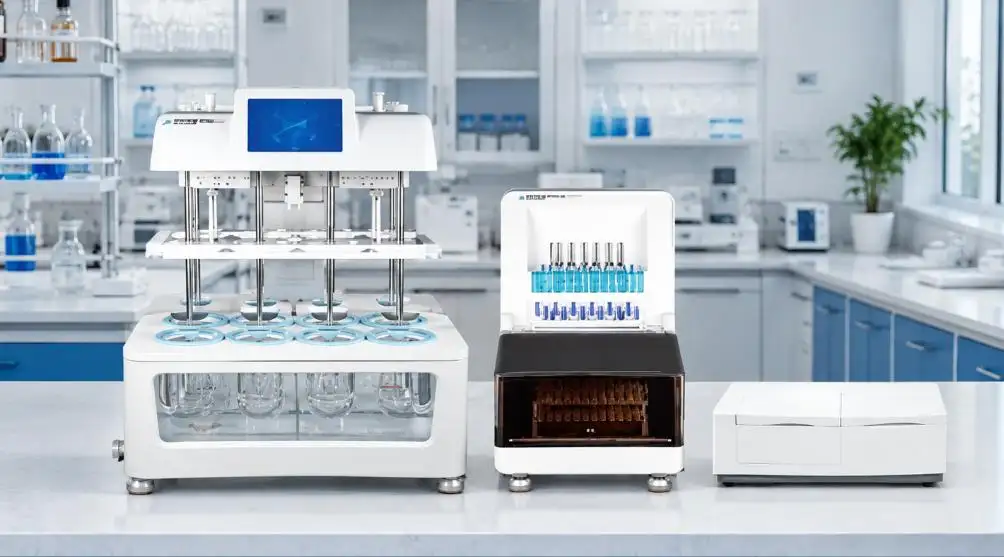
Raytor's automated configuration includes a 120-position tray for 1.5 mL vials, support for 10 mL tubes, high-precision sampling pumps, and automated online filtration, which can reduce repetitive handling during multi-time-point dissolution studies.
Qualification Should Include Hardware, Software and Electronic Records
For regulated Pharma QC Lab Instruments, qualification should cover dissolution mechanics, optical performance, sampling accuracy, filtration, calculation logic, and data management.
Raytor states that its operating system supports FDA 21 CFR Part 11 requirements and automatically generates protected electronic data files during testing. This should still be verified during supplier qualification through user-access control, audit-trail review, method-change history, raw-data retention, backup, and electronic-signature functionality. FDA guidance makes clear that Part 11 responsibilities depend on how regulated electronic records are created, maintained, retrieved, and controlled.
Selecting Pharma QC Lab Instruments by Method Evidence
The strong purchasing decision is not based on the highest throughput specification. It is based on whether the system can reproduce the laboratory's real analytical method.
Before selecting Pharma QC Lab Instruments, QC teams should verify API UV specificity, pathlength suitability, filter recovery, sampling volume accuracy, carryover, electronic data controls, qualification documentation, and preventive maintenance requirements.
Raytor combines controlled dissolution mechanics, automated liquid handling, selectable 1–10 mm UV flow cells, online filtration, real-time analysis, and electronic data management within one integrated QC workflow. Laboratories evaluating online UV-Vis dissolution can work with Raytor to confirm method compatibility and configure the analytical path around the formulation rather than adapting the formulation to the instrument.
FAQs
Q1. Which online dissolution analysis instruments does Raytor offer?
Raytor offers integrated pharmaceutical dissolution solutions featuring automated sampling, UV-Vis analysis, and electronic data management. Raytor's online UV dissolution architecture automates the execution of prescribed dissolution, sampling, and UV detections in real time.
Q2. Can Raytor Pharma QC Lab devices conduct real-time UV-Vis dissolution analysis?
According to Raytor, their online dissolution system incorporates fiber-optic technology and UV-Vis, enabling true real-time analysis. The system is designed to minimize the handling of samples and to generate dissolution data during the analysis as opposed to a post-run analysis.
Q3. What optical pathlengths does Raytor offer for online UV dissolution testing?
Raytor provides flow cells with 1–10 mm pathlengths. Lower pathlengths are suitable for higher concentration samples, whereas longer pathlengths help to improve response for lower concentrations, depending on API absorptility and the validated range.
Q4. What linearity and repeatability does Raytor mention for their UV dissolution system?
Raytor mentions a linearity of R² > 0.9995 and RSD <2.0% for 10 replicate tests. While these are valuable measures of performance for a given instrument, a given laboratory would still need to perform a formulation validation for accuracy, specificity, recovery, precision, and range.
Q5. How precisely does Raytor's automated sampling system control sample volume?
According to the manufacturer, the sampling volume error is specified at ≤±2% for closed-loop sampling mode and ≤±5% for open-loop sampling mode. This matter indicates that open-loop sampling means a removal of sample medium from the sample vessel, whereas the closed-loop mode considers recirculation or return of the sampled liquid.