






CE Certified Laboratory Equipment for Dissolution Testing
2026-08-19


Pharmaceutical dissolution testing is not controlled by RPM and bath temperature alone. A 50 rpm paddle method can still produce vessel-to-vessel differences when the shaft is off-center, the vessel is tilted, the basket wobbles, or sampling occurs late. Evaluating CE Certified Laboratory Equipment therefore requires a system-level view of hydrodynamics, mechanical geometry, temperature, sampling, data handling, and qualification.
What Does CE Certified Mean for Laboratory Equipment?
CE Certified Laboratory Equipment generally refers to laboratory equipment bearing the CE marking, indicating that the manufacturer has assessed the product against the applicable EU safety, health, performance, and environmental requirements for placing it on the European Economic Area market. CE is not an EU-issued quality certificate; responsibility for conformity normally rests with the manufacturer.
Before affixing the CE mark, the manufacturer must:
•Identify the applicable EU directives or regulations and relevant harmonized standards;
•Verify product-specific safety and performance requirements;
•Complete the required conformity assessment and testing;
•Involve a notified body where the applicable legislation requires third-party assessment;
•Prepare and retain technical documentation;
•Issue an EU Declaration of Conformity (DoC);
•Affix the CE marking visibly and legibly to the product.
For pharmaceutical dissolution systems, CE conformity should be evaluated separately from USP/Ph. Eur. method suitability, equipment qualification, and 21 CFR Part 11 data-integrity requirements. CE marking alone does not demonstrate compliance with these pharmaceutical testing requirements.
Mechanical Accuracy Defines the Hydrodynamic Environment
The dissolution profile reflects the interaction of rotation speed, vessel geometry, paddle/basket position, centering, verticality, and wobble. Changing one can alter local fluid velocity and shear around the dosage form.
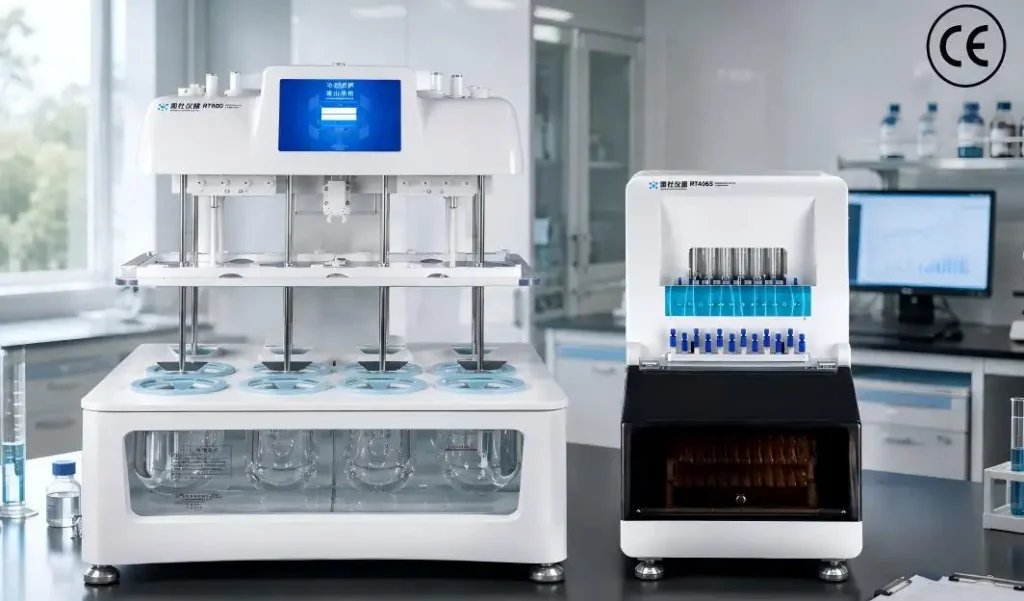
Raytor's RT600 8-position Dissolution Apparatus and RT612 12-position Dissolution Apparatus both offer a 0–300 rpm speed range with 0.01 rpm resolution, while steady-speed error is controlled within ≤±0.3 rpm. Temperature resolution is 0.01°C, but the more meaningful performance specification is the ≤±0.2°C temperature accuracy. This distinction is important because a finer display increment does not necessarily indicate higher operating accuracy.
| Critical Control | Raytor RT600 / RT612 Performance | Analytical Effect |
| Speed stability | ≤±0.3 rpm | Limits hydrodynamic drift |
| Temperature accuracy | ≤±0.2°C | Controls viscosity, solubility, and diffusion |
| Vessel/shaft verticality | 90°±0.5° | Reduces asymmetric flow |
| Centering deviation | <±2.0 mm | Keeps stirring geometry aligned |
| Depth positioning | <±1.0 mm | Maintains repeatable paddle/basket position |
| Shaft/basket wobble | <±1.0 mm | Reduces rotational variability |
These specifications demonstrate how CE Certified Laboratory Equipment should be evaluated by its ability to control the complete physical dissolution environment rather than simply by maximum RPM or vessel capacity. Both the Raytor RT600 and RT612 also specify an instrument level of <0.5°, highlighting the importance of bench leveling, shaft alignment, and apparatus geometry in maintaining consistent dissolution test conditions.
Basket, Paddle and Flow-Through Methods Solve Different Problems
Basket vs. Paddle
Basket systems contain the dosage form inside a rotating mesh assembly, making basket geometry and wobble critical. Paddle systems place the sample near the vessel bottom, so paddle height, centering and vessel symmetry become especially important.
Neither method is universally better. Selection must follow the dosage form, monograph and method-development objective.
When Flow-Through Testing Is More Appropriate
Flow-through cell testing continuously moves medium through the sample cell. It can be useful where sink conditions, medium renewal or specialized release behavior are difficult to manage with conventional basket or paddle testing.
The correct procurement question is not "Which apparatus is more advanced?" but "Which architecture reproduces the required release environment?"
Manual Sampling vs. Automated Sampling
Sampling can become a major source of variability in multi-time-point studies. Manual procedures introduce differences in timing, probe depth, withdrawn volume, filtration delay and media replacement.
Raytor's automated architecture supports 1–20 mL sampling, up to 20 programmable samples, ≤±1% sampling precision, a first sampling point from 3 minutes, and routine subsequent intervals from 5 minutes. These controls become valuable when many vessels must be sampled at closely defined time points.
Automation still requires validation. Laboratories should examine:
•Filter recovery and adsorption;
•Tubing carryover;
•Withdrawn-volume correction;
•Replacement-medium accuracy;
•Synchronization between sampling and dissolution time.
For CE Certified Laboratory Equipment, automation should reduce analyst-dependent variation without hiding these analytical controls.
Match Vessel Capacity to Real Throughput
More vessels are useful only when they match workflow. Raytor provides 8- and 12-position dissolution configurations with the same published core controls for speed, temperature, verticality, centering and wobble.
An 8-position system may fit stable routine QC, while 12 positions can support parallel formulation comparison or higher-throughput work. The decision should follow:
Batch Structure → Vessel Count → Sampling Frequency → Analyst Workload → Automation Level → Qualification Burden
This prevents extra capacity from adding bench space and qualification effort without improving analytical output.
Installation and Maintenance Protect Published Accuracy
Even high-performance CE Certified Laboratory Equipment can generate poor data on an unstable bench or with worn components.
Routine control should include:
•Checking levelness and environmental vibration;
•Inspecting vessels, shafts, paddles and baskets;
•Confirming RPM with calibrated equipment;
•Measuring actual vessel temperature;
•Cleaning probes, filters and tubing under validated procedures.
Installation is therefore part of the measurement system, not a one-time facility task.
CE, Pharmacopeial Suitability and Data Integrity Are Different
A CE mark does not by itself prove USP method suitability or 21 CFR Part 11 compliance.
| Verification Layer | What It Answers |
| CE conformity | Does the product meet applicable EU product legislation? |
| USP/Ph. Eur. suitability | Does the apparatus support the required pharmacopoeial method? |
| Qualification/PVT | Does the assembled system perform within verified limits? |
| Data integrity | Are electronic records and access controls appropriately managed? |
Raytor lists CE among its company certifications, while its dissolution systems publish support for major pharmacopoeial methods and digital functionality intended to support FDA 21 CFR Part 11 workflows. Buyers should still verify these claims against documentation for the exact configuration supplied.
Final Words
The effective CE Certified Laboratory Equipment is the system whose mechanical control, sampling architecture, documentation and throughput match the validated dissolution method.
Raytor offers measurable performance data for alignment, temperature, speed control and automated sampling rather than relying only on broad equipment claims. Laboratories evaluating a new dissolution platform can use these specifications as a technical baseline, then contact Raytor to confirm method compatibility, qualification documentation and the appropriate system configuration.
FAQs
Q1. What CE Certified Laboratory Equipment does Raytor offer for dissolution testing?
Raytor offers pharmaceutical dissolution equipment for both QC and R&D labs that cover 8-position and 12-position systems, automated sampling configurations, media preparation systems and flow through cell dissolution units.
Q2. Are Raytor dissolution systems CE certified?
Raytor mentions CE as a certification. When CE documentation is required for purchase or regulatory submissions, customers must require the EU Declaration of Conformity for the specific equipment model and configuration.
Q3. What speed range do Raytor dissolution testers support?
The RT600 and RT612 models of Raytor dissolution systems operate in the speed range of 0-300 rpm with a resolution of 0.01 rpm and a steady-state speed error of ≤±0.3 rpm.
Q4. How accurately do Raytor dissolution systems control temperature?
Raytor's RT600 and RT612 models claim 0.01°C temperature resolution and ≤±0.2°C temperature control for temperature control.
Q5. How does Raytor control mechanical alignment during dissolution testing?
Raytor sets the verticality of vessels and shafts at 90°±0.5°. The deviations are specified as ±2.0 mm for centering, ±1.0 mm for depth position, ±1.0 mm for wobble of the shaft and basket.