






Pharmaceutical QC Instruments for High-Throughput Drug Quality Control Laboratories
2026-08-20


High-throughput pharmaceutical quality control is not achieved simply by increasing the number of dissolution vessels. In routine release testing and stability programs, the real constraint is usually the complete workflow—from dosing and hydrodynamic control to timed sampling, filtration, vial handling, instrumental analysis, cleaning, and data review.

For this reason, Pharmaceutical QC Instruments should be evaluated as part of a connected analytical process. A system that produces samples faster than the laboratory can filter, analyze, or review them does not increase usable throughput; it only moves the bottleneck downstream.
Throughput Should Be Measured From Test Start to Reportable Result
A useful capacity model begins with the sample load generated by each dissolution run.
For an eight-vessel test with ten collection points:
8 vessels × 10 time points = 80 samples per run
At four runs per shift, the laboratory must manage as many as 320 sample vials, before accounting for repeats, standards, blanks, or system suitability samples.
This is why high-throughput Pharmaceutical QC Instruments must balance several stages:
•Synchronized product dosing;
•Stable RPM and temperature control;
•Repeatable timed sampling;
•Filtration and sample transfer;
•HPLC or UV analytical capacity;
•Cleaning and method changeover;
•Electronic record review.
A higher vessel count is useful only when these downstream stages can absorb the additional workload.
Hydrodynamic Control Starts With More Than RPM
Dissolution performance is highly sensitive to fluid-flow conditions around the paddle or basket. Rotational speed matters, but so do centering, shaft alignment, vessel verticality, immersion depth, and wobble.
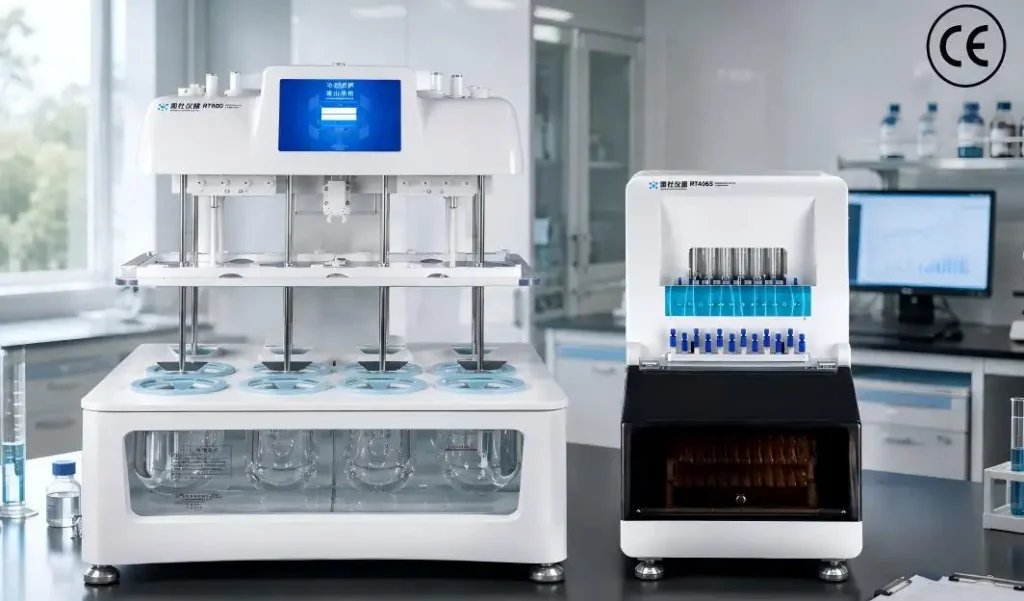
Raytor's automated dissolution platform illustrates how these variables are controlled together. Its drive system operates over 0–300 rpm, with 0.01 rpm resolution and a published steady-speed error of ≤±0.3 rpm. The distinction is important: resolution describes the setting increment, while steady-speed error better represents actual operating control.
Mechanical geometry is specified as:
•Vessel verticality: 90° ±0.5°;
•Shaft verticality: 90° ±0.5°;
•Centering deviation: <±2.0 mm;
•Depth-positioning deviation: <±1.0 mm;
•Shaft/basket wobble: <±1.0 mm.
These values matter because even accurate RPM cannot compensate for asymmetric stirring geometry.
| Critical Control | Raytor Performance | Analytical Effect |
| Speed stability | ≤±0.3 rpm | Limits hydrodynamic drift |
| Temperature accuracy | ≤±0.2°C | Controls viscosity, solubility and diffusion |
| Centering deviation | <±2.0 mm | Maintains rotational geometry |
| Depth positioning | <±1.0 mm | Reproduces paddle/basket position |
| Shaft/basket wobble | <±1.0 mm | Reduces local flow disturbance |
For Pharmaceutical QC Instruments, these mechanical parameters should be reviewed together rather than treated as isolated specifications.
Temperature Accuracy Is More Important Than Display Resolution
Dissolution media properties change with temperature. Small deviations can alter viscosity, diffusion behavior, drug solubility, and ultimately the observed dissolution rate.
Raytor specifies:
•0.01°C temperature resolution;
•≤±0.2°C temperature accuracy.
The latter is the more meaningful process-control parameter. A fine display increment does not prove equivalent operating accuracy.
This distinction is especially important when laboratories compare Pharmaceutical QC Instruments based mainly on digital display specifications.
Automated Sampling Must Match the Validated Method
High-throughput work creates a timing problem when multiple vessels must be sampled at closely controlled intervals. Manual sampling can introduce analyst-to-analyst variation, especially at early time points.
Raytor integrates automatic synchronous dosing and programmed sampling with:
•1–20 mL sampling range;
•≤±1% sampling precision;
•120-position sample collection capacity;
•First programmed sampling point from 3 minutes;
•Subsequent routine sampling intervals from 5 minutes.
These capabilities can significantly reduce manual intervention, but they must still be checked against the actual dissolution method.
For example, a method requiring samples at 2, 5, 10, and 15 minutes cannot automatically be assumed compatible simply because the instrument has an autosampler.
Sampling volume must also be considered cumulatively. Removing repeated aliquots changes vessel volume unless medium is replaced or the method applies a validated calculation correction.
More Automation Does Not Eliminate Sample-Path Risk
A dissolution sample travels through more components than the vessel itself:
Vessel → Probe → Tubing → Filter → Pump → Vial → UV/HPLC
Each stage can introduce analytical bias.
Typical risks include:
•Drug adsorption to tubing surfaces;
•Filter retention;
•Dead volume in sampling lines;
•Carryover between samples;
•Incomplete flushing;
•Inaccurate transferred volume.
Raytor uses Teflon sampling pipelines to reduce adsorption risk and provides an optional dual online filtration system. In high-throughput Pharmaceutical QC Instruments, this can reduce repeated manual filtration and shorten analyst handling time.
However, automated filtration must still be validated. Laboratories should establish filter recovery, tubing recovery, carryover, flushing volume, and compatibility with the specific drug product.
Compare System Architecture, Not Only Vessel Count
Different QC workloads require different forms of automation.
| System Type | Main Advantage | Main Constraint | Best Fit |
| Manual dissolution | Flexible setup | High analyst workload | Low-volume development |
| 8-position automated system | Balanced automation and footprint | Moderate parallel capacity | Routine QC and stability |
| 12/14-position system | Higher parallel testing | Greater sample load | High-volume release testing |
| Multi-batch automation | Repeated unattended runs | Higher system complexity | Large repetitive workloads |
An automated eight-position system may outperform a larger manual tester when dosing, sampling, filtration, vial collection, and records are integrated. Conversely, laboratories running large numbers of identical tests may benefit more from higher-position or multi-batch configurations.
HPLC and UV Capacity Must Match Dissolution Capacity
One of the most common high-throughput design errors is accelerating sample generation without expanding analytical capacity.
Offline HPLC offers high selectivity but may become the dominant queue. UV analysis can provide faster processing for suitable methods, while online analytical integration can reduce sample handling further.
Therefore, selection of Pharmaceutical QC Instruments should consider:
•Chromatographic runtime per sample;
•Autosampler tray capacity;
•Dilution requirements;
•Expected samples per dissolution run;
•Overnight or unattended analysis;
•Data-review workload.
The objective is balanced throughput, not maximum speed at a single process step.
Maintenance and Qualification Define Sustainable Capacity
Daily throughput should include planned downtime. Pumps, filters, tubing, shafts, vessels, and temperature-control systems all require periodic inspection or verification.
A practical maintenance program should cover:
•RPM verification;
•Temperature verification;
•Level and mechanical alignment;
•Sampling-volume verification;
•Pump and tubing inspection;
•Filter replacement;
•Line flushing and carryover testing;
•Preventive maintenance documentation.
For regulated laboratories, these controls sit alongside apparatus qualification and USP performance verification rather than replacing them.
Data Integrity Is Part of Instrument Performance
Modern Pharmaceutical QC Instruments increasingly generate electronic records that must remain traceable throughout the analytical lifecycle.
Raytor's operating environment is designed to meet FDA 21 CFR Part 11 requirements and supports centralized laboratory instrument connectivity. In practice, laboratories should still assess system validation, user access, audit trails, record retention, electronic signatures, backup, and review procedures within their own quality system.
Part 11 capability should therefore be treated as a validation requirement—not as a simple marketing label or automatic regulatory approval.
Select Pharmaceutical QC Instruments From the Workflow Backward
Before purchasing a high-throughput dissolution platform, laboratories should quantify:
•Batches and samples per day;
•Required vessel positions;
•Number and timing of sampling points;
•Sample volume and replacement strategy;
•Filtration and dilution requirements;
•HPLC or UV capacity;
•Cleaning and changeover frequency;
•Qualification and data-integrity requirements.
The best Pharmaceutical QC Instruments are those that maintain control across hydrodynamics, temperature, sampling, filtration, maintenance, and electronic records while keeping each stage of the laboratory workflow balanced.
For QC laboratories moving toward higher automation, Raytor provides dissolution solutions that combine controlled mechanical geometry, precise temperature and speed regulation, automated dosing and sampling, large-capacity sample collection, optional online filtration, and digital data management. Laboratories evaluating new Pharmaceutical QC Instruments can use these capabilities as a technical basis for matching the system to validated methods and real daily workload rather than selecting equipment on vessel count alone.
FAQs
Q1. What Pharmaceutical QC Instruments does Raytor provide?
Raytor focuses on providing instruments for pharmaceutical laboratories to aid in the QC steps of the dissolution test. Instruments include fully automated, sampling, filtration, and collection of samples. Raytor instruments also include automation for the laboratory to manage data.
Q2. How does Raytor support high-throughput pharmaceutical QC laboratories?
Raytor combines multiple steps that would otherwise need to be done manually, like synchronized dosing, programming of sampling, online filtration, sample collection, and sample drawing. Laboratories are able to better manage repeated dissolution tests.
Q3. What speed-control performance does Raytor provide for dissolution testing?
Raytor automated dissolution testing has a range of 0 to 300 rpm with 0.01 rpm resolution and a published steady-speed error of ≤±0.3 rpm. Steady-speed error is more valuable when evaluating hydrodynamic reproducibility.
Q4. How accurately does Raytor control dissolution temperature?
Raytor indicates a temperature resolution of 0.01°C and temperature accuracy of ≤±0.2°C. Temperature accuracy is more important because changes in temperature of the dissolution medium can alter the viscosity, solubility, and diffusion.
Q5. How does Raytor control mechanical geometry in dissolution testing?
Raytor offers a vertical deviation of a shaft and vessel of 90°±0.5°, centering deviation of ±2.0 mm, deviation in position of ±1.0 mm, and wobbling of ± 1.0 mm. These maintain constant hydrodynamic conditions.